

Could a celiac disease test at home give you a clear answer? It can make blood testing more convenient, but a result alone may not confirm or rule out celiac disease. The test, your preparation and clinical follow-up all matter.
If symptoms have you wondering whether gluten could be involved, it’s understandable to want a straightforward next step. Home collection can make arranging a test easier, but reliability also depends on collecting and handling the sample correctly. Stopping gluten before testing may affect how results are interpreted, so speak with a clinician before changing your diet.
This guide explains what at-home testing can and can’t tell you, how to prepare and what to do after receiving a result. You’ll also learn how home blood testing can fit into a clinically guided testing journey in the UAE. Bewell provides home medical services in Dubai, Sharjah, Abu Dhabi and Ajman, including a convenient way to arrange blood testing and follow-up care.
Key Takeaways
- A celiac disease test at home may be convenient, but the testing pathway and clinical follow-up matter when interpreting a result.
- Learn why celiac blood testing may include tissue transglutaminase IgA and total IgA, and how HLA-DQ2/DQ8 testing is different.
- Compare self-test kits, professional home blood collection and clinic-based assessment to understand differences in support and follow-up.
- Prepare for a clinician discussion by noting your symptoms, family history, previous test results and any changes to your diet.
Celiac Disease Test at Home: What It Can and Cannot Tell You
Can a celiac disease test at home confirm that you have celiac disease? Not on its own. Celiac disease is an autoimmune condition in which gluten triggers an immune response that can damage the lining of the small intestine. A home option may help with screening or blood sample collection, but the result needs to be considered in context and may require clinical follow-up.
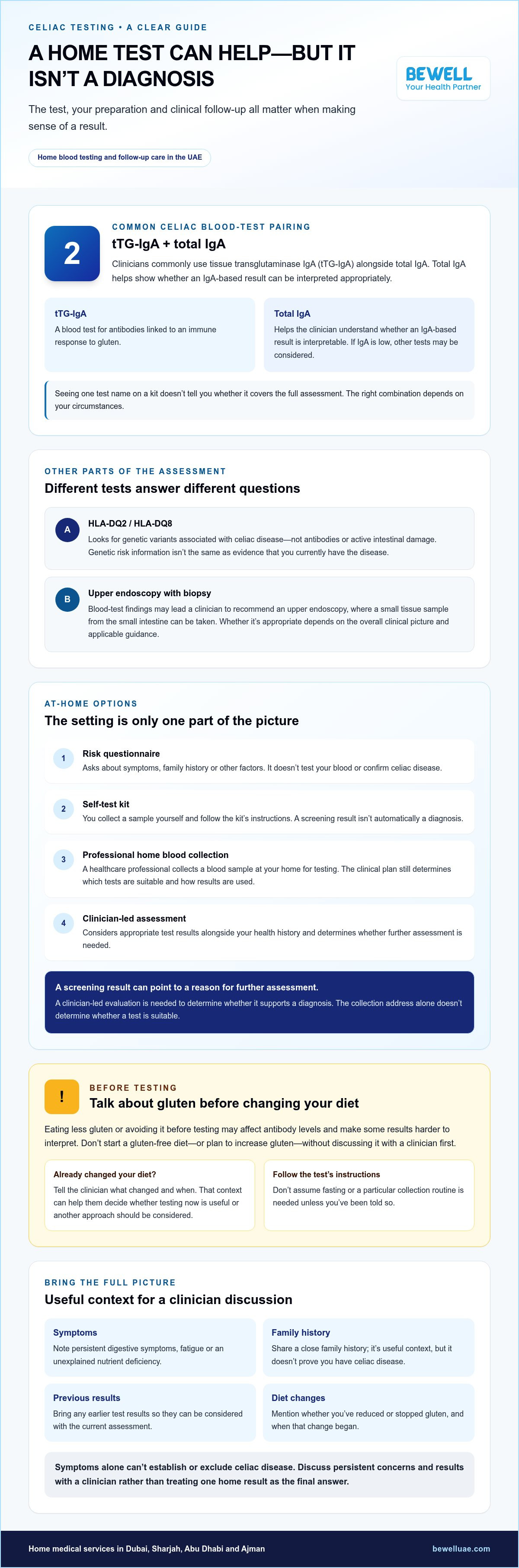
It helps to distinguish three things. A risk questionnaire asks about symptoms, family history or other factors, but doesn’t test your blood. A screening test looks for a possible sign of the condition, but a positive or negative result isn’t automatically a diagnosis. A clinician-led assessment considers appropriate test results alongside your health history and determines whether further assessment is needed. Celiac disease can affect people in different ways, so a single result shouldn’t be interpreted in isolation.
Symptoms alone can’t establish or exclude celiac disease. Digestive discomfort can have many causes, and some people with celiac disease have few noticeable digestive symptoms. If symptoms persist, discuss testing with a clinician instead of relying on symptoms, a questionnaire or a home result to settle the question.
When celiac disease testing may be worth discussing
Persistent digestive symptoms, such as ongoing diarrhoea, bloating or abdominal discomfort, can be a reason to ask a clinician whether testing is appropriate. A close family history is useful context, too, but it doesn’t prove you have the condition. Celiac disease may also be associated with symptoms beyond digestion, such as fatigue or an unexplained nutrient deficiency. Share the full picture, even if your concerns don’t seem directly related to food.
What “at-home celiac test” can mean
The phrase can refer to different processes. With a self-test, you collect a sample yourself and follow the kit’s instructions. With professional home blood collection, a healthcare professional collects a sample at your home for testing. These options differ in who collects the sample and how results are interpreted. In either case, the collection address alone doesn’t determine whether a test is suitable or how its result should be used.
A screening result can flag a reason for further assessment, but a clinician-led evaluation is needed to determine whether it supports a diagnosis. Before choosing a home option, understand what the test measures, who reviews the result and what follow-up is available. A risk questionnaire can help you prepare for a clinical discussion, but it can’t confirm celiac disease. Likewise, don’t treat a reassuring screening result as definitive if symptoms or other concerns remain. Discuss the result and your next steps with a clinician.
Which Celiac Disease Tests May Be Used, and Why Preparation Matters
Home blood collection can make the sample-taking step more convenient, but the clinical plan still determines which tests are appropriate and how results are used. For suspected celiac disease, clinicians commonly use serology, or blood tests that look for antibodies linked to an immune response to gluten. The National Institute of Diabetes and Digestive and Kidney Diseases outlines blood testing and possible follow-up procedures as part of diagnosis.
Blood tests, antibodies, and genetic testing
Celiac serology commonly includes tissue transglutaminase IgA, often shortened to tTG-IgA, alongside total IgA. Total IgA helps show whether the body has enough of this antibody type for an IgA-based result to be interpreted appropriately. If IgA is low, a clinician may consider other tests. The right combination depends on your circumstances, so seeing one test name on a kit doesn’t tell you whether it covers the full assessment.
HLA-DQ2 and HLA-DQ8 testing is different. It looks for genetic variants associated with celiac disease, not antibodies or active intestinal damage. The result can inform an assessment, but genetic risk information isn’t the same as evidence that you currently have the disease. It also doesn’t replace every other diagnostic step.
Blood test findings may lead a clinician to recommend an upper endoscopy, during which a small sample of tissue from the small intestine can be taken for biopsy. Whether this is appropriate depends on the overall clinical picture and applicable guidance. A celiac disease test at home should therefore be considered one possible part of a wider testing pathway, not a stand-alone verdict.
Why changing your diet first can complicate testing
Eating less gluten or avoiding it before testing may affect antibody levels and make some results harder to interpret. Gluten intake before testing matters because reducing or removing gluten can change the signals that celiac blood tests are designed to detect. Don’t start a gluten-free diet or make a plan to increase gluten without discussing it with a clinician first. They can advise what preparation is suitable for your situation.
Before arranging a test, tell the clinician if you’ve already changed your diet and when that change began. This context can help them decide whether testing now is useful or whether another approach should be considered. Follow the instructions for the specific test. Don’t assume fasting or a particular collection routine is needed unless you’ve been told so.
If a clinician recommends blood testing, home medical services can make arranging collection easier. In the UAE, you can explore Bewell’s blood testing and home medical services as a convenient part of your care journey.
At-Home Celiac Testing Compared With Clinical Testing
A home setting doesn’t automatically make a test unreliable. What matters is whether the test suits the question, whether the sample is collected and handled as instructed, and how the result fits into a clinical assessment. A celiac disease test at home can mean anything from a self-test kit to professional blood collection at your residence. Compare the process rather than assuming these options offer the same level of support.
| Option | Convenience | Professional involvement | Interpretation and follow-up |
|---|---|---|---|
| Self-test kit | Can be completed at home, following the kit’s instructions. | You collect the sample yourself; professional involvement depends on the service. | Check what the test screens for and how results are explained. A result may need clinical review. |
| Professional home blood collection | Brings the collection step to your home, reducing travel and scheduling logistics. | A healthcare professional collects the sample. | Collection support doesn’t necessarily include diagnosis. Discuss results and next steps with a clinician. |
| Clinic-based assessment | Requires attending a clinic, but can bring assessment and testing into one care setting. | A clinician can assess your concerns and guide the testing plan. | Provides a direct route to discuss findings and whether further assessment is appropriate. |
What to compare before choosing a home test
Start by checking what the test actually measures. Does it look for a clinically relevant marker, or only assess risk based on answers to questions? Then find out who processes the sample and how results are communicated. A positive, unclear or unexpected result may need clinical follow-up. A reassuring result may not resolve ongoing concerns. Treat testing as one step, not the whole care pathway.
Sample location alone doesn’t establish accuracy. A clinic-collected sample and a professionally collected sample at home aren’t inherently different in diagnostic value simply because one was taken outside a clinic. The test itself, sample handling and interpretation all matter. Follow the collection instructions carefully, and don’t assume a home kit includes a clinician’s review.
When a clinician-led route may be more suitable
Prioritise clinician guidance if symptoms are significant, persistent or worsening. It’s also useful if you’ve already reduced or stopped eating gluten, since that can complicate test selection and interpretation. Share those details before testing so the clinician can advise on a suitable next step.
For people in Dubai who prefer home collection, professional blood test home service can make arranging a blood test more convenient. Consider it a collection route within a clinically guided process, not a substitute for clinical assessment or follow-up.
How to Prepare for a Celiac Disease Test at Home in the UAE
A little preparation can make a home blood test easier to arrange and help your clinician interpret the result. Share useful health information and follow the instructions for the specific test. Don’t assume fasting is required, and don’t change your diet just to prepare. If you’re arranging home care in Dubai, Sharjah, Abu Dhabi or Ajman, plan around the sample appointment and any instructions from the clinical team.
Before scheduling home blood collection
Before arranging a celiac disease test at home, collect the details a clinician may need to choose and interpret testing. Keep your notes simple: when symptoms began, how often they occur and whether they’re changing. Mention family history, previous results and any changes to the amount of gluten you eat, even if those changes happened some time ago.
- Write down your symptoms. Note what you’ve experienced, how long it has been happening and whether it is persistent, improving or worsening.
- Gather relevant history. Record celiac disease in your family, previous test results and any related health concerns you’ve discussed with a clinician.
- Describe your diet accurately. Tell the clinician if you’ve reduced or stopped eating gluten, and avoid starting a gluten-free diet solely to prepare for testing.
- Follow test-specific instructions. Use the guidance given by the clinical team for your particular test. Don’t assume fasting or a specific collection routine is needed unless you’ve been told so.
- Plan the home appointment. Share practical details needed to arrange the visit, such as your location in the UAE and a suitable time for collection.
These steps help keep the discussion focused without trying to self-diagnose. If you’re unsure whether a past dietary change matters, mention it rather than trying to correct it on your own. A clinician can advise how it affects the testing plan.
After the sample: understanding results and next steps
A result needs to be considered alongside your symptoms, medical history and the test that was performed. A positive result may prompt further clinical assessment. Depending on the findings, a clinician may discuss additional testing, which can include endoscopy and a small-intestine biopsy, though this isn’t necessary for every person. The next step depends on the individual assessment.
If the result is negative but symptoms continue, or if the result is unclear, arrange a clinical review rather than treating it as the final word. Bring your notes and any previous results to that discussion. Home collection can make the sample-taking step more convenient, but it doesn’t replace advice on what the findings mean or whether further assessment is appropriate.
Arrange Convenient Home Blood Testing With Bewell in the UAE
Once you and your clinician have discussed the right testing pathway, arranging blood collection is the practical next step. Home-based care can reduce the logistics of travelling to a clinic, especially if getting there or fitting an appointment into your routine is difficult. It doesn’t change what a test can establish, though. A celiac disease test at home still needs to suit your clinical question, with results considered in context.
Bewell provides blood tests and home medical services in the UAE, including in Dubai, Sharjah, Abu Dhabi and Ajman. If your clinician has recommended blood testing, home care offers a convenient way to arrange that step. Share the reason for testing and relevant health history with the care team so the collection is understood as part of your wider care journey. Don’t assume a general blood test or broad health screen answers a specific question about celiac disease.
A practical home-testing route for UAE residents
Before making arrangements, be clear about what your clinician is investigating and what testing they’ve advised. Have relevant details ready, such as symptoms, previous results and any changes to your diet. This helps connect blood collection to the wider clinical plan, rather than treating a sample or result as a diagnosis on its own.
If you’re also considering broader preventive screening for reasons beyond suspected celiac disease, Bewell’s health checkup packages guide can help you explore that separate topic. A general checkup and a targeted assessment answer different questions, so keep your clinician’s recommendation for celiac testing separate from broader wellness screening.
Take the next step with clear expectations
Keep the decision straightforward: choose a test that fits the clinical question, follow its instructions and have the result interpreted alongside your symptoms and medical history. Home blood collection can make the logistics easier, but it doesn’t by itself confirm or rule out celiac disease. If a result is positive, negative or unclear and concerns remain, discuss what it means and whether further assessment is appropriate with your clinician.
For residents in Dubai, Sharjah, Abu Dhabi and Ajman, Bewell’s home medical services provide a convenient UAE-based option for arranging blood testing. Explore Bewell’s home care and blood testing services as part of a plan guided by your clinician.
Take Your Next Step With Confidence
Choosing a celiac disease test at home is part of a bigger decision: how to get a clear, clinically useful answer. Before arranging testing, write down the question you want answered and the details you want your clinician to consider. This can make your next conversation more focused and help you decide what action makes sense for your situation.
It’s reasonable to want convenience, especially when symptoms are affecting everyday life. Let convenience support your care, not replace it. A thoughtful testing plan gives you a clearer route from concern to appropriate assessment, without relying on guesswork or treating one result as the whole story.
When you’re ready to plan home-based care, explore Bewell’s services and choose a practical next step that fits your needs.
With the right guidance, you can move forward calmly and make informed decisions about your health.
Frequently Asked Questions
Can an at-home celiac disease test diagnose celiac disease?
A celiac disease test at home can’t diagnose the condition on its own. An at-home option may provide a risk screen or a blood-test result, but neither automatically establishes a diagnosis. The pathway depends on what the test measures, your symptoms and diet history. A clinician may recommend additional assessment, though the next step varies based on individual findings. Treat a positive or borderline result as a prompt for review, not a final answer.
Should I stop eating gluten before a celiac disease blood test?
Don’t stop eating gluten without discussing it with a clinician first. Reducing or removing gluten can affect some test results, so mention any dietary changes and when you made them. For example, explain whether you avoid wheat, barley or rye, and whether this is occasional or ongoing. Your clinician can advise whether and how testing should proceed. Don’t start a gluten challenge or change your diet based on general online guidance.
Are at-home celiac tests accurate?
Reliability depends on the specific test, correct sample collection and handling, and appropriate interpretation, not simply whether collection happens at home or in a clinic. Professional home blood collection differs from self-directed screening, where you may collect the sample and receive a limited explanation. Before choosing an option, understand what it measures and how an unexpected result can be reviewed. No single accuracy figure applies to every test.
Can children have a celiac disease test at home?
Children can be evaluated for celiac disease, but the appropriate tests and next steps depend on age, symptoms and clinical context. Don’t assume an adult home kit is suitable for a child or that its instructions apply. If a child has ongoing digestive concerns, growth or nutrition issues, or a relevant family history, discuss these with a qualified clinician. They can guide the evaluation and explain how results should be followed up.
What should I do if my celiac disease test is negative but I still have symptoms?
A negative result may not answer every clinical question, particularly if you reduced gluten before testing, the test wasn’t suited to your situation, or symptoms continue. Note when symptoms occur and any dietary changes, then share these details and the result with a clinician. They can assess whether the finding addresses your concerns or whether another assessment is appropriate. Avoid diagnosing yourself based on one result alone.
Does a positive HLA-DQ2 or HLA-DQ8 result mean I have celiac disease?
No. A positive HLA-DQ2 or HLA-DQ8 result provides genetic information associated with susceptibility, not proof of active celiac disease. Genetic testing answers a different question from antibody testing and needs clinical context. Share the result with a clinician, who can consider it alongside your symptoms, blood-test findings, diet history and previous investigations. The genetic result alone shouldn’t be used to make a diagnosis or decide on treatment.

Article by
Ph.Fares
He is a pharmacist, healthcare entrepreneur, and preventive healthcare advocate with a Bachelor of Pharmacy from the University of Sharjah. He is a Health Coach at Bewell Therapeutic Services in the UAE, where he focuses on making preventive healthcare more accessible through digital health solutions, laboratory testing, health screenings, and personalized checkup packages.
With experience spanning pharmacy practice, medical sales, laboratory services, healthcare marketing, and business development, Fares combines pharmaceutical knowledge with commercial and technological expertise. His professional mission is to promote health awareness, encourage early disease detection, and help individuals make informed decisions about their health through accessible, patient-centered healthcare services.

