

The broadest food panel may not be the right test for an allergy. For food allergy testing at home in Dubai, an IgE blood test is relevant when symptoms appear soon after eating a particular food. An IgG panel assesses food sensitivity or intolerance and answers a different question. Both use a blood sample, but their results are not interchangeable.
If you’re unsure which test fits your symptoms, that’s understandable. The names can sound similar, but each test has a different purpose and meaning. A positive result also needs context: it doesn’t automatically mean you should remove that food from your diet.
This guide explains how IgE and IgG testing differ, what to consider before a home blood test, and how to interpret a positive result. You’ll also learn what can affect testing in Dubai and when a blood test may not be the right way to assess a suspected food allergy.
Key Takeaways
- Choose a test based on the timing and pattern of symptoms: IgE and IgG panels assess different responses and aren’t interchangeable.
- Prepare according to the test type. Fasting isn’t required for IgG food intolerance testing, while antihistamine guidance differs between sensitivity testing and blood IgE testing.
- A positive result needs to be interpreted alongside symptoms and food history; it doesn’t automatically mean you should eliminate that food.
- At-home blood collection can make testing more convenient, but the sample must still be collected and handled according to the testing process.
- Use the result as a starting point for understanding your symptoms, not as a standalone diagnosis or a reason to make major diet changes.
At-Home Food Intolerance and Food Allergy Tests: Are Home Kits Reliable?
Home testing can be useful when the test matches your symptoms and the blood sample is collected and processed correctly. First, distinguish tests for IgE-mediated allergy from IgG food intolerance panels: they measure different antibody responses and cannot be used interchangeably.
Home Sample Collection
In Dubai, at-home blood collection can involve a healthcare professional visiting to take a sample, rather than you collecting it yourself with a kit. Check how collection works and how the sample is sent to the laboratory. Collection and handling matter because a result is useful only when the correct sample is tested with the intended assay.
Check that the test name clearly identifies IgE or IgG, and that its report lists the foods or allergens assessed. Dubai IgE food panels may cover 44 food items, while IgG intolerance panels can assess a broader selection. A larger panel doesn’t automatically make a test more suitable: match the panel to the question you’re trying to answer.
Clinic and Home Collection Options
Clinic collection means travelling to a facility for a blood draw; at-home collection brings the draw to your chosen location. Both provide a sample for laboratory testing, but the practical choice depends on access, scheduling and comfort. Before booking, find out whether a professional will collect the sample or whether you’ll use a self-collection kit.
For a food intolerance blood test, the price depends on panel size and collection arrangements, and is provided after a quote request. Ask what the panel measures, how the sample is collected, and when results are expected. In Dubai, IgG food intolerance panel results are commonly listed as taking 5-7 business days; turnaround can vary by test and processing.
Reliability also depends on interpreting the result in context. IgE-related food allergy symptoms typically begin within minutes to two hours after eating. IgG sensitivity symptoms may appear four to 72 hours later, but timing alone cannot establish which test is appropriate. Record the food, amount, symptoms and timing before choosing a panel. A clear pattern helps distinguish an immediate reaction from delayed digestive discomfort.
Home collection doesn’t change what an antibody test measures, only where the sample is taken. A positive IgE result indicates sensitisation, but doesn’t by itself confirm that eating the food causes an allergic reaction. An IgG result likewise isn’t proof that a food causes digestive symptoms. Avoid removing foods based on a panel alone; consider the result alongside your symptom history.
Look for a report that identifies the test type, foods assessed and measured results. Make sure you understand the findings before acting on them. If symptoms suggest a severe or immediate allergic reaction, a home blood test is not an emergency assessment. Seek urgent medical help for severe symptoms rather than waiting for a laboratory report.
Test preparation and fasting
At-home testing carries risks if you treat a result as a diagnosis or remove foods without considering the context. See an allergist for suspected immediate reactions, recurring symptoms, or help interpreting results. Seek urgent care for severe symptoms such as breathing difficulty.
Preparation depends on whether the test measures IgE or IgG. Fasting isn’t required before IgG food intolerance testing. Follow the collection instructions for your specific blood test, and have your identification and test details ready when the sample collector arrives. Keep a record of foods eaten and symptoms, including when they started, to help interpret the result.
Antihistamine advice differs by test type. Preparation guidance for food sensitivity testing advises avoiding antihistamines for 3-5 days beforehand. However, antihistamines don’t change circulating IgE levels in a blood test, so they can be continued as prescribed for that test. Don’t stop prescribed medication solely to prepare for an intolerance test; discuss medication changes with the prescriber.
Ask about the expected turnaround when arranging collection. A blood IgE food allergy panel covering 40-100 allergens has a listed result time of 24-48 hours. Food allergy testing in Dubai is also commonly listed at 2 to 3 days, depending on the panel and laboratory processing. IgG intolerance testing follows a different timeline, so don’t assume the same test or lab has the same reporting schedule.
Home collection can make a blood draw more convenient, but convenience alone doesn’t establish test quality. Look for clear information about which proteins or allergens the test measures, how the sample is collected, and where it is processed. A blood draw by a licensed professional and a report identifying the assay make the process easier to understand. A self-collection kit should give direct instructions for taking, storing and returning the sample.
Blood tests also have limits. An IgE result can show sensitisation, but doesn’t prove that eating a food causes symptoms. An IgG intolerance test measures a different antibody response and cannot diagnose an IgE food allergy. Neither panel answers every question about digestive discomfort or non-IgE conditions. Consider symptom timing, food history and the test’s stated purpose before deciding what to do. Don’t start a restrictive diet based on a result alone: removing several foods can make it harder to identify the cause of symptoms and maintain a balanced diet.
Understanding sensitisation and positive results
A positive food allergy test needs to be considered alongside your symptoms and the food involved. For an IgE blood test, a positive result shows sensitisation: the immune system has produced IgE antibodies to a food. It doesn’t establish by itself that eating the food causes an allergic reaction. Someone can be sensitised without experiencing symptoms after eating that food.
Compare the result with a specific episode. Note the food, amount eaten, symptoms and how soon they began. An IgE-related reaction commonly starts within minutes of eating a trigger food. For example, a positive result for egg deserves closer attention if symptoms repeatedly follow eating egg. A positive result without a matching history needs careful interpretation, not an automatic dietary ban.
IgG food intolerance reports use separate thresholds. One Dubai panel classifies an IgG antibody result of at least 30 U/ml as a high antibody reaction. Results from 24 to 29 U/ml are classed as moderate sensitivity, while 23 U/ml or less is classed as no significant reaction. These are that panel’s reporting categories, not proof that the food causes symptoms or an IgE allergy.
Use the package report to identify the test type, foods included and meaning assigned to each result. An IgG result reflects the antibody response measured by the test; it doesn’t confirm that avoiding the food will relieve digestive symptoms. An IgE result also needs to be considered alongside symptom timing and history. Don’t treat IgE and IgG findings as if they measured the same response.
Before changing your diet, keep a food-and-symptom record. Include meals, ingredients, symptom details and timing. Share it with a qualified health professional when discussing a positive food allergy test. This can help distinguish a repeatable reaction from an isolated symptom and protect nutrition if food restrictions are considered. Avoid removing several foods at once, as this makes it harder to identify which change affected your symptoms.
Laboratory turnaround depends on the test type and processing. Dubai IgE blood panels covering 40-100 allergens are listed with results in 24-48 hours. IgG food intolerance panel results are listed at 5-7 business days. These timelines describe different tests, so compare the stated turnaround for your chosen package rather than assuming every laboratory uses one schedule.
When the result arrives, check the units and reference categories before acting. For example, read an IgG result of 30 U/ml using that panel’s threshold, then compare it with your symptom record. A number is a laboratory finding, not a complete explanation of your response to food. Use the result to guide a focused follow-up, while keeping meals balanced and your nutrition varied.
At-home food allergy blood testing in Dubai
At-home food allergy testing in Dubai uses a blood sample to assess IgE antibodies linked to selected foods. The panel should match the suspected trigger and the reactions you’ve experienced.
Sample collection and laboratory analysis are separate steps. For licensing questions, consult official Dubai health authority guidance about the service and laboratory involved.
Blood Testing for Allergy Assessment
An IgE blood test measures antibodies associated with the immune system’s response to specific allergens. A Dubai food allergy panel may assess 44 food items. A combined panel can screen 53 common allergens using IgE and 222 food proteins using IgG. Review the panel description so you know which results relate to allergy testing and which relate to intolerance.
Tell the doctor which foods have caused reactions, such as a particular fruit, and when symptoms began. This history helps focus interpretation on relevant findings rather than treating every item in a package as an equally likely trigger.
Skin Prick and Blood Testing
A skin prick test places a small amount of an allergen on the skin and checks for a local response. Results are listed as available in 15 minutes. An IgE blood test uses a sample analysed by a laboratory, allowing collection at home while the results are processed.
These methods assess allergic responses differently. A doctor can consider your reaction history, test findings and practical needs when deciding on an approach. For example, a blood test may suit someone who prefers laboratory analysis to an in-clinic skin procedure.
Antihistamines are an important distinction for blood testing. They don’t change circulating IgE levels measured by a blood test, so patients can continue taking them as prescribed. This differs from some skin tests, where medication may affect the skin response. Don’t stop prescribed medicine without advice from the clinician managing your care.
Panel size also matters. A combined food and environmental allergy test may cover more than 200 items, while a Dubai allergy profile described in the market covers 295 food and environmental allergens. A larger panel doesn’t establish which foods cause symptoms. Match the panel to the question you need answered.
For food allergy testing at home in Dubai, check that the report identifies the test type and foods assessed. The laboratory measures selected antibodies and reports its findings. Review the results alongside your food and symptom record, including the timing of reactions. A positive result can indicate sensitisation; it doesn’t independently prove that eating the food triggers symptoms.
If you’re considering food allergy testing at home in Dubai, record suspected foods and reactions before arranging a test. For a suspected immediate reaction, discuss your history with a doctor. A home blood test can provide laboratory evidence, but doesn’t replace assessment of the reaction itself. Severe symptoms require urgent medical care, not a wait for test results.
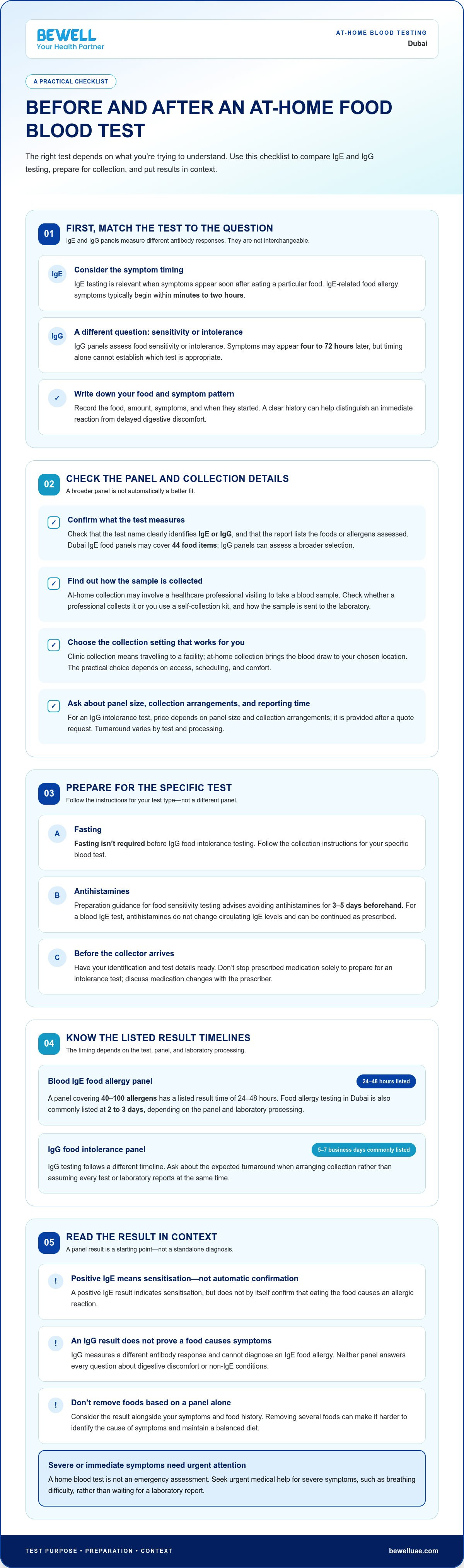
How do I book a home food allergy test in Dubai, and what are the steps?
Start by matching the test to your concern. For suspected immediate reactions, ask about an IgE food allergy blood test; an IgG intolerance panel measures a different response. Booking a home test involves choosing the panel, arranging sample collection, and understanding how results will be delivered and interpreted.
- Write down your symptoms. Record the food, amount, reaction and timing for each episode. For example, note whether symptoms began soon after eating a specific ingredient or appeared later.
- Select the test type. Choose an IgE test for suspected allergic reactions, not an IgG panel simply because it lists more foods. A Dubai IgE panel may cover 44 food items, so review the included allergens against your symptom notes.
- Check the collection method. Confirm whether a trained collector visits your Dubai address or whether the service provides a self-collection kit. Ask how the sample is labelled, stored and transported to the laboratory.
- Arrange the appointment. Provide your location, preferred collection time and the test name. Keep the booking details available, and follow the instructions for the chosen collection method.
- Prepare for the sample. Fasting isn’t required for IgG intolerance testing. For an IgE blood test, antihistamines don’t change circulating IgE levels, so continue them as prescribed. Follow any test-specific collection instructions.
- Review the report. Check the test type, foods assessed, result units and laboratory interpretation. Compare findings with your symptom record rather than treating a positive result as proof that eating the food causes a reaction.
Before confirming, clarify what the selected package includes. A food allergy panel and an intolerance panel answer different questions, even when both use a blood sample. Ask how results are shared and what turnaround applies to that specific test; Dubai IgE blood panels covering 40-100 allergens are listed with results in 24-48 hours, while other panels may follow different timelines.
Keep your report and food-and-symptom notes together. If you discuss the findings with a doctor, these records can help connect a laboratory result with real reactions. Don’t remove several foods at once based only on a panel; a broad dietary change can make it harder to identify the trigger and maintain balanced nutrition.
Choose a collection option that suits your needs, then book the relevant blood test.
Bewell: Health Checkup Packs
Bewell offers Health Checkup Packs and Blood Tests to support people planning their next step after reviewing food-related symptoms. If digestive symptoms arise after eating, a food intolerance blood test may be relevant to discuss; intolerance testing and IgE allergy testing assess different responses, so they shouldn’t be treated as interchangeable. For suspected immediate allergic reactions, consider IgE test results in the context of your symptoms and discuss them with a doctor. Choose a test based on the question you need answered, whether you’re exploring digestive concerns or reviewing broader health markers. Bewell also offers Health Scans as part of its health services.
Make your next step a considered one
Use your food and symptom notes to focus a conversation about what to test next. If you’re considering food allergy testing at home in Dubai, keep the goal clear: investigate a suspected allergic response, rather than relying on a broad panel to explain every digestive symptom. A test result is most useful when considered alongside your history and day-to-day experience.
Bewell offers Blood Tests and Health Checkup Packs for people taking a structured approach to their health. Its IV DRIPS & INJ are another part of its health services, separate from investigating food reactions. Choose the option that fits your current need, and keep allergy questions focused on the appropriate test and interpretation.
A clear next step can help you move forward with greater confidence and a more informed plan.
Frequently Asked Questions
IgE vs IgG Testing: Which Food Test Do You Need?
Choose IgE testing for suspected allergic reactions and IgG testing for food intolerance questions. For example, a recurring reaction soon after eating peanuts points toward discussing IgE assessment, while delayed digestive discomfort raises a different question. Before booking, note the foods involved and the pattern you’ve noticed. That context helps you select a panel for the concern you want to investigate.
Do I need to stop my antihistamines before this test?
For a blood IgE test, antihistamines don’t change circulating IgE levels, so continue them as prescribed. Some food sensitivity testing instructions advise avoiding antihistamines for 3-5 days, but don’t stop prescribed medication without discussing it with the prescriber. Check the preparation instructions for the specific test you’ve booked, since advice for an IgG sensitivity panel and a blood allergy test can differ.
Should I stop eating the foods that tested positive?
No. Don’t remove a food from your diet based only on a positive antibody result. Compare the finding with your actual experiences, including ingredients, portion size and symptoms. For example, a positive result for milk doesn’t establish by itself that milk causes your symptoms. Discuss persistent reactions and any proposed elimination with a qualified health professional, especially before removing several foods that contribute important nutrients.
Why Get Tested?
Testing can help investigate a repeatable pattern and provide information to discuss with a health professional. It may be useful if you’ve noticed symptoms after a particular meal but can’t identify the ingredient. Keep a food diary with meal details and symptom timing before testing. This can make a conversation about the right test more focused than ordering a broad panel without a clear concern.
What types of food allergy tests can be done at home in Dubai?
The at-home option described here is blood collection for laboratory testing, including IgE allergy panels and IgG food intolerance panels. A skin prick test is a different method, performed in a clinical setting rather than as a home blood test. Check whether the panel measures IgE or IgG, and review which foods it includes before arranging collection in Dubai.
Are at-home food allergy test kits available in Dubai, and which providers offer them?
Home testing may involve a professional visiting to collect a blood sample or a self-collection kit, depending on the service. Bewell offers Blood Tests and home nursing; its home-visit service includes sample collection by a certified nurse. Confirm that the selected test suits your concern and understand how the sample will be transported and reported. Don’t assume every home blood test assesses food allergy.
How much do home food allergy testing services cost in Dubai?
The price depends on the test and panel selected, the foods or allergens included, and the collection arrangements; it’s provided after a quote request. An IgE allergy panel and an IgG intolerance panel are different tests, so compare what each package measures rather than choosing by panel size alone. Ask what the quoted service includes, such as collection and laboratory analysis.
Can a nurse collect a food allergy test sample at home in Dubai?
Home blood sample collection by a nurse is available through home-visit services in the UAE. Before arranging a visit, make sure the booked blood test uses a sample the nurse can collect at home, and have your identification and booking details ready. The nurse collects the sample, and the selected laboratory performs the analysis. A home visit doesn’t make the test result a diagnosis on its own.

Article by
Ph.Fares
He is a pharmacist, healthcare entrepreneur, and preventive healthcare advocate with a Bachelor of Pharmacy from the University of Sharjah. He is a Health Coach at Bewell Therapeutic Services in the UAE, where he focuses on making preventive healthcare more accessible through digital health solutions, laboratory testing, health screenings, and personalized checkup packages.
With experience spanning pharmacy practice, medical sales, laboratory services, healthcare marketing, and business development, Fares combines pharmaceutical knowledge with commercial and technological expertise. His professional mission is to promote health awareness, encourage early disease detection, and help individuals make informed decisions about their health through accessible, patient-centered healthcare services.
