

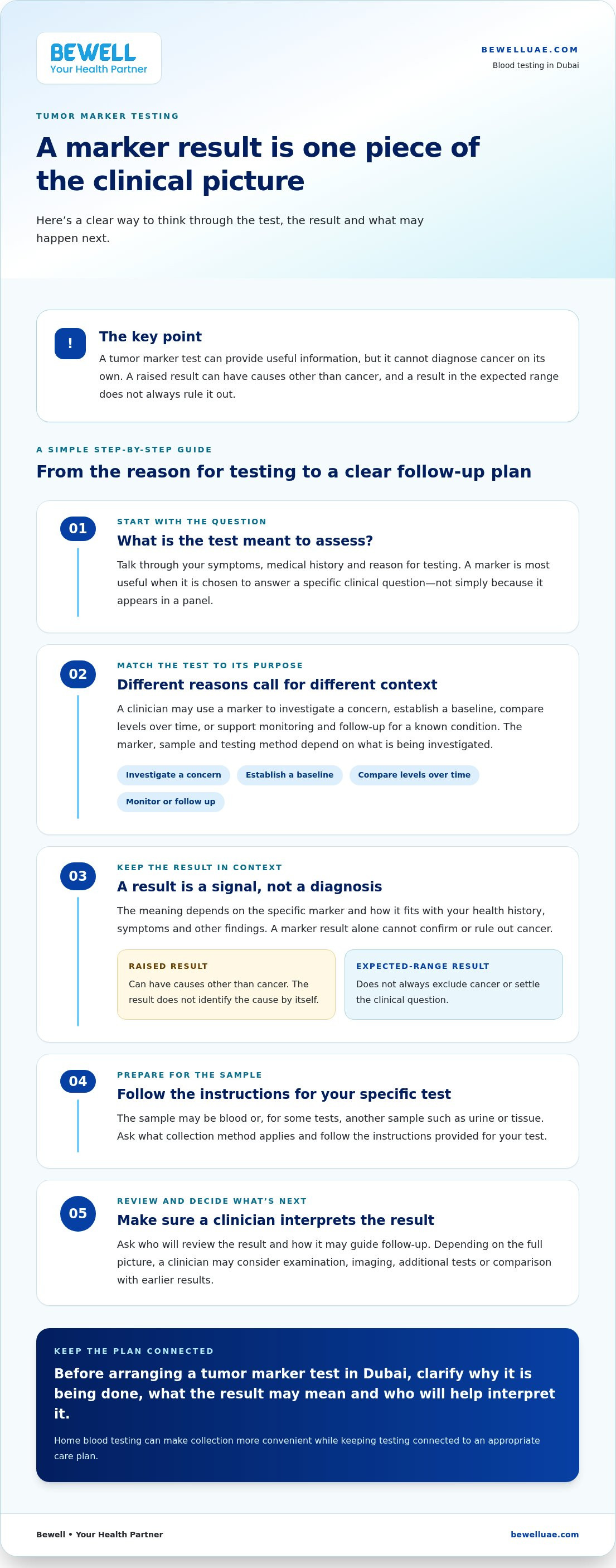
Could a test called a tumor marker test diagnose cancer on its own? Usually, no. Marker levels can be affected by conditions other than cancer, and a result within the expected range doesn’t always rule cancer out. That’s why a tumor marker test dubai residents consider is most useful when it answers a specific clinical question and is interpreted alongside other information.
It’s understandable to want a clear answer from a blood test, especially when you’re unsure which marker applies to your concern or how to prepare. The right test depends on your symptoms, medical history and reason for testing. Before arranging it, discuss what the test is meant to assess, who will review the result and what follow-up might be appropriate.
This guide explains what tumor markers can and can’t tell you, how clinicians select tests, and what to discuss before your blood draw. You’ll also learn what to expect when arranging blood testing in Dubai. If a home visit is more convenient, Bewell provides blood tests and home-based medical services in Dubai, Sharjah, Abu Dhabi and Ajman.
Key Takeaways
- Match a marker test to a specific clinical question rather than choosing a panel by name alone.
- Compare tests by their purpose, marker examples, any accompanying assessment and how results will be interpreted.
- Before arranging a tumor marker test dubai, discuss the reason for testing and what the result may mean for your next steps.
- Follow the instructions for your specific blood test, then review the result with a clinician.
- Home blood testing can make collection more convenient while keeping testing connected to an appropriate care plan.
Tumor Marker Test in Dubai: What Is It Used For?
A tumor marker is a measurable substance that can help inform a specific clinical question. Depending on the marker, it may be associated with a tumor or with the body’s response to it. Markers can be measured in blood and, for some tests, in other samples such as urine or tissue. The sample and testing method depend on what is being investigated.
A marker result is a signal, not a diagnosis. A raised level can have causes other than cancer, while a result in the expected range doesn’t always exclude it. A tumor marker test Dubai residents might consider is most useful when selected for a clear clinical reason, rather than treated as a stand-alone answer. The overview What are Tumor Markers? also describes how markers may be used and why results need context.
What does a tumor marker measure?
Markers include substances produced by some tumors or by the body in response to disease. Different markers relate to different clinical questions, so one result cannot provide a general measure of whether someone has cancer. A clinician considers the marker alongside the person’s health history, symptoms and other findings. A tumor marker can contribute evidence, but it isn’t a definitive diagnosis.
The reason for measuring a marker also matters. A clinician may use a test to investigate a concern, establish a baseline or compare levels over time. A change in level can be informative in some circumstances, but its meaning depends on the marker and the wider clinical picture. When discussing a test, ask what it is meant to help assess and how the result will be used.
When might a clinician use tumor marker testing?
The purpose matters. Screening looks for signs of disease in people who may not have symptoms, and selected marker tests may be considered in particular clinical contexts. That doesn’t mean a broad panel is suitable for everyone or that a marker blood test replaces other screening methods. The appropriate approach depends on personal history and the clinical question being addressed.
During a diagnostic assessment, a clinician may use a marker as one part of investigating symptoms or other findings. Examination, imaging and additional tests may also be needed to understand what is happening. A marker result alone can’t confirm or rule out cancer, so it should be interpreted with the rest of the assessment.
Markers may also help monitor a known condition or support follow-up after treatment. In these situations, a clinician may compare results over time and consider them alongside treatment history, symptoms and other investigations. The purpose is to guide assessment and next steps, not to treat a single change as a conclusion. If you’re arranging testing in Dubai, start by clarifying what question the test is intended to answer and how the result will inform your care.
What Tumor Marker Results Can, and Cannot, Tell You
A tumor marker result can provide useful information, but it rarely answers a cancer-related question on its own. An elevated result doesn’t automatically mean cancer is present, and a result within the reference range doesn’t always exclude it. The meaning depends on the specific test and how the result fits with your symptoms, medical history and other findings.
Tumor marker results are supporting evidence, not standalone diagnoses. They need to be interpreted alongside clinical assessment and any other investigations relevant to the person. The National Cancer Institute’s Understanding Tumor Marker Tests explains how these tests may contribute to cancer care while also outlining their limitations.
Why can a marker result be abnormal without cancer?
An elevated marker can have explanations other than cancer. The result doesn’t identify its cause by itself. To interpret it, the clinician needs to know which test was performed, the laboratory’s reference range and the reason the test was ordered.
A clinician considers the complete picture before recommending what to do next. That may include your symptoms, health history, examination findings and results from other tests. Depending on that context, the next step may be further assessment, follow-up or a different investigation. Avoid drawing a conclusion from a result in isolation, even if it’s flagged as higher than the reference range.
Why does a normal result not always settle the question?
Not every cancer produces a measurable change in a marker, and a test may not detect a marker in every situation. A normal result can be useful information without settling the clinical question. If symptoms or other findings still need assessment, a clinician may recommend additional investigations despite a result within the reference range.
This isn’t a reason to assume the worst. It’s a reminder that the test has a defined role and should be considered with other evidence. Your clinician can explain whether the result changes the next step or whether examination, imaging or another test is more appropriate.
For example, if a marker was ordered to assess a particular concern, its value depends on how closely it relates to that concern and what else is known about your health. A result that changes over time may also be considered differently from a single measurement, especially when testing is part of monitoring or follow-up. Ask why a repeat test is being considered and how the new result will be compared with earlier findings.
If you’re arranging a tumor marker test dubai, ask the clinician what question the test is intended to answer, what a high or normal result could mean, and what follow-up may be needed. Bewell provides blood tests and home-based medical services, offering a convenient way to arrange blood collection as part of a clinician-guided care plan. Explore home-based blood testing as a collection option.
How to Compare Tumor Marker Tests and Screening Packages
Compare tests by what they’re intended to help assess, not simply by the number of markers included. A single test may be selected to address a focused clinical question, while a package can combine several blood tests and other investigations. Neither format is automatically the better choice. The right fit depends on your reason for testing, health history and plan for interpreting results.
The markers below are examples, not recommendations for everyone or a universal screening panel. Their use depends on the clinical context, and an individual marker result needs appropriate interpretation.
| Clinical purpose | Marker examples | Possible accompanying assessment | Interpretation needs |
|---|---|---|---|
| Assessing a prostate-related question | PSA | Clinical history, examination or other investigations as appropriate | Interpret in context; the result alone doesn’t establish a diagnosis. |
| Assessing a concern involving the ovaries | CA-125 | Symptoms, examination and, where indicated, imaging | Consider the reason for testing and other clinical findings. |
| Supporting assessment or monitoring in selected situations | CEA | Medical history and relevant follow-up investigations | Purpose and trends may matter; it isn’t a general cancer screen. |
| Investigating selected liver-related or other clinical questions | AFP | History, examination and other tests guided by the clinical question | Interpret alongside other evidence, not in isolation. |
| Supporting assessment of selected digestive-system concerns | CA 19-9 | Symptoms, history and other investigations when indicated | A result alone cannot confirm a specific condition. |
Single marker test or multi-test package: what is the difference?
A targeted test focuses on one marker chosen for a particular reason. A package may include several markers, other laboratory tests or imaging. More items don’t automatically make the assessment more suitable: some tests may not relate to your clinical question. Compare what is included with the reason for testing, and find out whether the package includes a consultation and a clear plan for discussing results and follow-up.
For broader context on the kinds of checks that may be grouped together, see Comprehensive Health Checkup Packages in Dubai: The 2026 Wellness Guide. A general health package and a clinician-directed tumor marker assessment serve different purposes. Before choosing between them, consider whether you need a broad health review or a test selected to address a particular concern.
Which questions help make a clinically informed comparison?
Start by clarifying why testing is being considered. Ask which markers are included, what other assessment accompanies them, and who will interpret the findings. Also understand how results will be discussed and what follow-up could involve. These details matter as much as the panel list when weighing a tumor marker test dubai option.
MedlinePlus provides accessible background on test purpose and results in Preparing for a Tumor Marker Test. Use that information to support, not replace, a conversation with your clinician. A package comparison can help you understand what’s included, but your personal clinical context determines whether those tests are appropriate. For a practical comparison, write down the reason for testing, the included markers, any additional assessments and how the result will be reviewed.
How to Prepare for a Tumor Marker Blood Test and Follow Up
A little preparation can make your blood test easier to arrange and help ensure the result is considered in the right context. If you’re considering a tumor marker test in Dubai, follow the instructions provided for the specific test. Preparation can vary, so don’t assume fasting or another step is required unless you’ve been told to do it.
- Discuss the reason for testing. Tell your clinician what prompted the test, including relevant symptoms, medical history and current medicines. This helps them decide whether a marker test fits the clinical question and whether any other assessment is needed.
- Confirm the test-specific instructions. Follow the guidance you receive about food, drink, medicines, timing or other preparation. Requirements depend on the test. If instructions are unclear, ask the clinician who arranged it before making changes to your routine or medication.
- Choose a practical collection arrangement. Blood collection at home can be a convenient option if it suits your care plan. Bewell provides blood tests and home-based medical services in Dubai, Sharjah, Abu Dhabi and Ajman. Home collection is about convenience; the test itself should still be guided by an appropriate clinical reason.
- Keep track of the follow-up plan. Find out how the result will be reviewed and who will explain it. Knowing how to discuss the report can help you avoid drawing conclusions from a flagged value or reference range on your own.
- Review the result with your clinician. Share any questions or unexpected findings with the ordering clinician. They can interpret the result alongside your health history and other relevant information, then explain whether follow-up is appropriate.
Before the sample is collected
Keep the instructions for your requested test handy, and follow them rather than relying on general advice about blood tests. Preparation may involve guidance about food, drink or timing, but fasting isn’t automatically required for every tumor marker test. Continue medicines as directed unless your clinician gives you different instructions. If you’re arranging home collection, have the collection details and your clinician’s instructions available.
For related information about arranging blood collection at home, the article Professional Blood Test Home Service: Clinical Excellence at Your Doorstep offers additional context. Convenient collection can simplify logistics, while the clinical purpose and interpretation remain part of the care plan.
After testing: interpreting results and planning next steps
Once the result is available, review it with the clinician who requested the test. A reference range describes the laboratory finding, but it doesn’t explain its meaning for you on its own. Ask what the result means in light of your symptoms and history, and whether any further assessment is appropriate. Next steps depend on the findings and your care plan.
Arrange Convenient Blood Testing in Dubai with a Clear Care Plan
Arranging a blood test is one part of the process. Before booking, make sure you understand why the test is being considered, who will review the result and how it fits into your care plan. Convenience matters, but it doesn’t replace clinical judgment or make a test appropriate by itself.
If you’re considering a tumor marker test in Dubai, a clinician should guide the choice and explain what the result may help assess. This keeps collection and follow-up connected to the original clinical question, rather than treating a lab report as a complete answer.
What a coordinated testing experience should help you do
A clear plan links the conversation before testing to the review afterward. Before arranging collection, know which test has been requested and what preparation instructions apply. Also understand who will interpret the result and how to discuss next steps. If the test is part of ongoing care, keep previous results and relevant medical information available for that discussion.
This coordination helps you know what to expect without making assumptions about what a result means. A convenient blood draw can make access simpler, but the test’s purpose, interpretation and any further assessment should remain guided by your clinician.
How Bewell supports convenient healthcare access
For people in Dubai who prefer care at home, Bewell provides home medical services, including blood testing. Home-based medical services are available in Dubai, Sharjah, Abu Dhabi and Ajman. Home collection can simplify logistics while you follow the instructions for your requested test and keep result review connected to the clinician overseeing your care.
As you plan, keep the request and any preparation guidance close at hand. Make sure you know who will review the result and how follow-up will be arranged. Those practical details help connect the blood draw to a useful next step, without assuming that a marker test on its own provides a diagnosis.
Explore Bewell’s healthcare services to learn about convenient care options, including blood testing and home-based medical services in Dubai, Sharjah, Abu Dhabi and Ajman.
Make Your Next Step a Clear One
If you’re considering a tumor marker test dubai, begin with a focused conversation about what you want to understand and how the result could guide your care. A useful next step isn’t simply booking a blood draw. It’s making sure the test has a clear purpose and that you know who will review the result with you.
Before arranging testing, keep your clinician’s instructions and any relevant health information together. This can make it easier to discuss the request, prepare as directed and follow up without relying on guesswork. If home collection would fit your routine, Bewell provides home-based medical services in Dubai, Sharjah, Abu Dhabi and Ajman.
Choose a testing arrangement that works for you, and keep clinical guidance at the centre of the process. A thoughtful plan can make the next step feel more manageable.
With clear guidance and convenient care, you can move forward with confidence.
Frequently Asked Questions
Can a tumor marker test diagnose cancer on its own?
No. A tumor marker result by itself isn’t a cancer diagnosis. A high result can have explanations other than cancer, and some cancers may not change the level of the marker being measured. If you receive a report, share it with the clinician who requested the test. Bring the full report and note any new symptoms or changes since the test was ordered, so the result can be considered alongside your current situation.
Are tumor marker tests suitable for routine screening for everyone?
Not necessarily. A marker test or broad panel isn’t automatically appropriate as routine screening for every person. The reason for testing matters: symptoms, family history and a previous diagnosis may each call for a different clinical discussion. Before arranging a test, tell your clinician what prompted your concern and ask what the requested test is intended to help assess. This can help clarify whether it fits your circumstances and what follow-up might be needed.
Which tumor markers may be included in a blood test?
Examples used in some cancer-related testing include PSA, CA-125, CEA, AFP and CA 19-9. They aren’t interchangeable, and their names alone don’t show whether a test is relevant to you. If a clinician has requested one, ask for the marker’s full name and the clinical question it relates to. That simple clarification can help you understand the request and prepare for a useful conversation about the result.
Do I need to fast before a tumor marker blood test?
Not always. Preparation depends on the specific test and whether other investigations are being collected at the same visit. Follow the instructions provided for your request rather than fasting as a precaution. Don’t stop or adjust regular medicines unless your clinician directs you to. If you have several tests booked together, make sure you have preparation guidance for the full set, since instructions may differ between tests.
What should I do if my tumor marker result is higher than the reference range?
Arrange a review with the clinician responsible for your care, and avoid treating the flagged value as a diagnosis. The report’s reference range is one part of interpretation; the marker, test method and reason for testing also matter. Keep the report available and ask what the result means for your specific care plan. Your clinician can advise whether further assessment is appropriate based on the overall findings.
Can I have a blood test collected at home in Dubai?
Home-based blood collection can be a convenient option in Dubai. Bewell provides blood tests and home medical services in Dubai, Sharjah, Abu Dhabi and Ajman. The test should follow the clinician’s request and any collection instructions, and the result should be reviewed appropriately. Keep the test request and clinical follow-up plan clear so the collection is connected to the reason for testing.
Does a normal tumor marker result mean I do not have cancer?
No. A normal result for one marker doesn’t rule out every cancer or settle every health concern. The test measures a particular marker, and some cancers may not cause a measurable change in it. If you still have symptoms or have been advised to complete another assessment, follow up with your clinician. Ask how the result affects your next step rather than using the number alone to decide what to do.

Article by
Ph.Fares
He is a pharmacist, healthcare entrepreneur, and preventive healthcare advocate with a Bachelor of Pharmacy from the University of Sharjah. He is a Health Coach at Bewell Therapeutic Services in the UAE, where he focuses on making preventive healthcare more accessible through digital health solutions, laboratory testing, health screenings, and personalized checkup packages.
With experience spanning pharmacy practice, medical sales, laboratory services, healthcare marketing, and business development, Fares combines pharmaceutical knowledge with commercial and technological expertise. His professional mission is to promote health awareness, encourage early disease detection, and help individuals make informed decisions about their health through accessible, patient-centered healthcare services.
